ELASTIC NETTING
 AUTOMATION
 BONE PROTECTION
The Role of Elastic Netting in Meat Processing Consistency and Yield Optimization

In industrial meat production, yield is everything. Even small yield gains can be financially rewarding. Elastic netting can have an effect on yield in several stages of production. Gaining some yield can depend on the tension of a single fibre. Controlling finished product diameter is a constant challenge for processors. Utilising high-performance meat netting is no longer just about packaging; it's a technical requirement for ensuring every joint meets exact specifications for the slicing line.
You understand that inconsistent product diameters directly erode your bottom line. This article explains how performance-grade elastic netting serves as a precision tool for enhancing product uniformity and increasing slicing yields.
Key Takeaways
- Understand the function of netting from a decorative wrap to a functional industrial tool for standardising product dimensions.
- Learn the technical distinctions between traditional and fixed diameter netting.
- Discover how high-performance meat processing netting combines inward pressure to minimise cavities and optimise meat binding, with diameter control, to maximise slicing yields through controlled protein expansion.
The Strategic Role of Meat Netting in Production Consistency
Industrial meat processing netting is a specialised elastic mesh used to compress and shape protein products during cooking. In modern high-volume facilities, the role of netting has transitioned from a simple aesthetic wrap to a functional production tool. Advances in netting manufacturing technology have allowed netting to perform additional roles in cooked meat production. When proteins are subjected to heat, they naturally expand and contract. Without external compression, the resulting product lacks the uniformity required for high-speed slicing systems. It's no longer about the visual pattern; it's about the technical control of the meat block.
Uniform heat distribution across the entire meat block is a critical operational benefit. By maintaining a consistent diameter, the product reaches its target internal temperature simultaneously from the surface to the core. Proper tension ensures that the product doesn't deform under its own weight during the cooking or smoking cycle, which prevents internal voids and ensures a safe, consistent end product.
Beyond Aesthetics: Functional Requirements for Industrial Netting
Industrial netting must provide constant compression to eliminate air pockets within restructured meat products. This pressure ensures a solid, void-free cross-section, which is essential for premium deli meats. During high-moisture cooking cycles, the netting must maintain its tensile strength without losing elasticity. This structural integrity facilitates consistent smoke penetration and colour development. In artisanal-style products, the netting pattern creates the characteristic surface texture that consumers associate with quality, while the material itself must remain non-reactive and durable at high temperatures.
The Impact on Standardised Slicing and Portioning
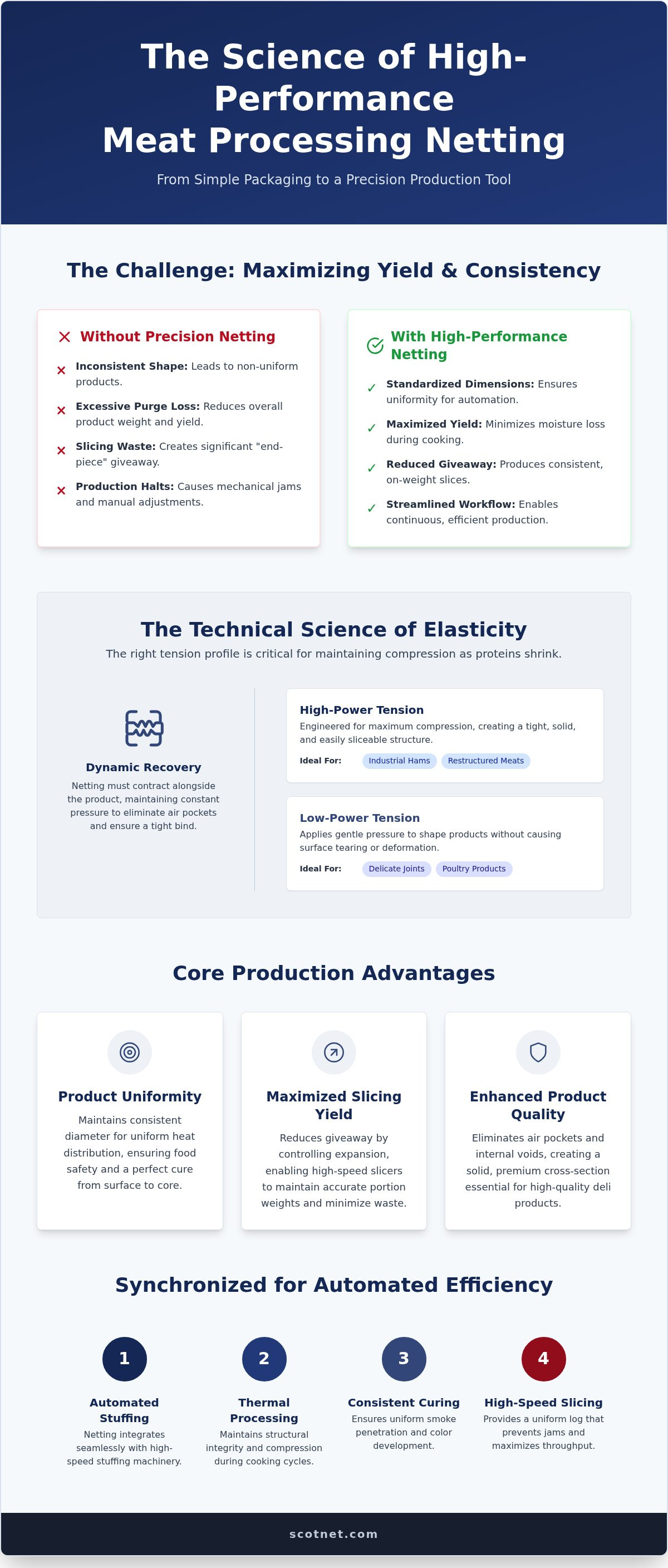
The primary economic driver for utilising high-performance meat processing netting is the reduction of giveaway. High-speed slicing equipment relies on a consistent product diameter to maintain accurate portion weights. If a meat log contracts unevenly, the slicer produces slices that deviate from the target weight, resulting in giveaway or underweight rejects. By controlling the expansion of the meat block, processors maximise the yield of saleable slices. This optimisation increases throughput for high-speed slicers because the machinery requires fewer adjustments. Reducing giveaway in retail-ready portioning directly improves the profitability of the production line. Consistent log shapes also prevent mechanical jams, ensuring a continuous and efficient automated workflow.
Understanding Elasticity: The Technical Science Behind Netting Tension
The efficacy of meat processing netting depends entirely on its elastic recovery properties. In an industrial context, elasticity isn't merely about stretch; it's about the consistent radial pressure applied to the protein throughout the entire production cycle. As meat proteins undergo thermal denaturation, they expel moisture and shrink. A high-performance net must possess the technical capability to contract alongside the product, maintaining constant compression. Without this dynamic recovery, the netting becomes loose, leading to air pockets, uneven shapes, and poor binding between meat pieces.
Selecting the correct tension profile is essential for yield optimisation. You can explore our range of tailored elastic netting to find the exact technical specification required for your specific production line. Standardising these tension levels ensures that every batch meets the same quality benchmarks, regardless of minor variations in raw material density.
Power vs. Compression: Finding the Yield Balance
In the technical evaluation of netting, "Power" is defined as the specific force required to stretch the mesh to its working diameter. It's a critical metric for production consistency. High-power netting is engineered for heavy, restructured products like industrial hams, where maximum compression is required to create a tight, sliceable structure. Conversely, delicate retail joints or poultry products require low-power netting. Applying excessive tension to soft proteins can cause surface tearing or product deformation, which negatively impacts visual appeal after stripping and slicing efficiency. Achieving the correct balance between power and compression ensures optimal bind without compromising the structural integrity of the meat.
Heat Resistance and Material Integrity
Industrial cooking cycles often reach temperatures exceeding 100°C. Elastic fibres must maintain their tensile recovery at these extremes without degradation. If the rubber or synthetic core of the netting fails during the heating phase, the product will lose its shape, resulting in significant slicing waste. Processors must ensure their materials comply with food safety and processing regulations, particularly regarding the migration of chemicals from elastic fibres at high temperatures. High-quality netting is designed to withstand steam, dry heat, and smoking cycles without "snap-back" failures during the subsequent cooling phase. This thermal stability ensures that the tension applied during the stuffing stage remains constant until the product is ready for packaging.
The relationship between tension and square count also dictates the final surface pattern. A higher square count combined with calibrated tension results in a sharp, defined pattern that enhances the artisanal appearance of smoked meats. Technical precision in fibre selection prevents the netting from sticking to the product surface, ensuring a clean strip during the final processing stages.
Industrial Netting Materials: Selecting for Durability and Safety
Selecting the appropriate material for meat processing netting is a technical decision that impacts both food safety and operational yield. While cotton netting remains a legacy choice for specific smoked products due to its natural absorbency, industrial polyester and high-performance synthetic blends are now the standard in high-volume facilities. These materials must provide high tensile strength and thermal stability to withstand the rigours of automated stuffing and high-temperature cooking cycles. Polyester fibres offer superior heat resistance and minimal moisture absorption, which is critical for optimising cooking yield through precise moisture management. Synthetic blends are engineered to maintain their elastic recovery without leaching chemicals, ensuring the structural integrity of the meat block remains intact from stuffing to stripping.
A significant operational challenge in high-speed lines is "meat pick," where protein fibres adhere to the mesh during the thermal process. This adhesion results in surface tearing and loss of saleable protein during the stripping phase. Utilising non-leaching, high-performance materials prevents the netting from becoming embedded in the meat surface. This material choice directly influences the final product's visual quality and weight retention. By selecting fibres with low-friction properties, processors can ensure that the netting acts as a functional shaping tool rather than a source of product degradation.
Food Safety Compliance and Global Standards
Manufacturers must ensure that all consumables adhere to FDA, EFSA, and BRC standards for food-grade materials. These certifications guarantee that the netting is produced in a controlled environment and is safe for direct food contact at high temperatures. Traceability is essential for industrial audit compliance; every batch of netting must be traceable back to its raw material source. To mitigate foreign body contamination risks, many plants now utilise high-visibility netting colours like blue or red. These colours ensure that any fragments are easily identified by vision systems or manual inspection during the final packaging stages.
Enhancing Product Release and Stripping Efficiency
Stripping efficiency is the ease of removing netting without damaging the product surface. To achieve high efficiency, advanced siliconization and specialised coating technologies are applied to the fibres. These coatings reduce the bond between the protein and the mesh, allowing for a clean release even after long cooking cycles. The mechanical design of the mesh also matters; specific square patterns are engineered to minimise the netting adhering to the meat. This synergy between material coating and mesh geometry ensures that the netting peels away cleanly, preserving the product's surface integrity and maximising the final slicing yield.
Optimising Yields: Maximising Slicing Performance
Industrial meat processing requires managing narrow margins where every percentage of yield directly impacts the bottom line. Commodity netting often fails because it lacks the consistent elastic recovery needed during thermal processing. High-performance meat netting acts as a functional compression sleeve, maintaining radial pressure as the product shrinks. This constant tension reduces purge loss, also known as cook loss, by preventing moisture expulsion from the protein matrix. By maintaining internal moisture, you sell more weight per unit and deliver a superior finished product.
Tailored netting patterns also play a critical role in flavour development and smoke absorption. By adjusting the cell count and tension, processors can increase the effective surface area exposed to heat and smoke. This ensures deeper penetration and a more uniform colour, which are essential for premium smoked products. Achieving first-time-right product dimensions reduces the need for expensive rework and ensures that every log entering the slicing line is optimised for maximum throughput. Purge is lost revenue; precision tensioning is the solution.
Calculating the ROI of High-Performance Netting
Purchasing decisions shouldn't focus solely on the cost per meter of the consumable. In high-volume plants, a 1% improvement in slicing yield can represent significant annual revenue gains. High-performance netting reduces the frequency of underweight slices, ensuring more of your raw material reaches the retail package. It also minimises labour costs associated with manual trimming or sorting defective products. If you're looking to upgrade your production efficiency, you can view our full range of industrial netting solutions to calculate the potential yield gains for your facility. Consistency in product appearance reinforces brand value, ensuring that retail-ready portions look identical in every batch.
Reducing Waste Through Precision Tensioning
Uniform compression prevents the accumulation of moisture and fat in localised pockets. These irregularities often cause structural failures when products are processed through high-speed, thin-slice deli lines. By maintaining a tight, consistent meat block, the netting ensures that the protein fibres remain bonded, which is crucial for achieving high-quality slices.
Advancing Efficiency with Automated Stuffing and Netting Systems
Integrating automated systems into the production floor is the final step in achieving absolute consistency. Manual stuffing and tying processes are often the primary bottlenecks in high-volume plants, introducing human variables that lead to inconsistent tension and product deformation. By transitioning to continuous automated stuffing, processors can significantly increase throughput while ensuring that every unit meets the exact specifications required for downstream slicing. Automated pressing equipment maintains a level of precision that manual labour simply cannot replicate, ensuring that the radial pressure remains identical across every batch.
Reducing operator fatigue is another significant benefit of automation. Mechanical assistance in the stuffing and tying phases improves workplace safety by eliminating the repetitive strain associated with manual processes. This shift doesn't just improve safety; it stabilises the production rhythm, ensuring a predictable flow of product through the facility. When the physical demands on the workforce are reduced, the focus shifts toward quality control and process monitoring, which further enhances the reliability of the meat processing netting application.
Scaling Production with Scotnet Automation Solutions
Scotnet provides an integrated approach to meat processing that covers the entire production lifecycle. Our expertise, built over 50 years since our founding in 1974, allows us to provide both the high-performance consumables and the specialised machinery required for industrial success. From specialised bone protection that reduces packaging weight to automated pressing machines, our solutions are designed for modularity and technical excellence. Equipment configurations can be customised for specific protein types, whether your facility processes beef, pork, or poultry. You can optimise your production line with Scotnet's automated solutions to achieve higher yields and superior product uniformity.
Optimising Industrial Output with Precision Netting Solutions
Achieving consistent production standards requires a technical approach to both consumables and machinery. Integrating synchronised automated systems ensures radial compression remains constant throughout the thermal cycle, reducing cook loss and maximising the volume of retail-ready slices. Selecting high-performance meat processing netting is a functional investment in yield recovery and brand uniformity. By prioritising stripping efficiency and material durability, processors can eliminate surface damage and reduce protein loss during the final production stages.
Explore Scotnet's Industrial Netting and Automation Solutions to enhance your facility's efficiency and output quality. Implementing these technical standards ensures your operation remains competitive in a demanding global market.
Frequently Asked Questions
How do I choose the right netting size for my product diameter?
Selecting the correct size involves matching the netting's working diameter to the stuffing horn and the final product's target dimensions. Using a size that's too small results in excessive tension and protein tearing, while an oversized net fails to provide sufficient compression. Our technical team are on hand to measure and advise.
Can industrial meat netting be used in high-temperature roasting applications?
High-performance meat processing netting is specifically engineered to withstand industrial roasting temperatures exceeding 100°C. Synthetic fibres like polyester are chosen for their thermal stability, ensuring the mesh doesn't degrade or lose elasticity during dry heat or steam cycles. It's critical to verify that the material is certified for high-temperature food contact to prevent chemical leaching or material failure.
How does netting tension affect the final cooking yield of ham and poultry?
Netting tension minimises purge loss by maintaining constant pressure on the protein matrix, which prevents moisture from being expelled during the cooking cycle. Calibrated tension ensures that the product maintains its structural integrity, leading to a more uniform density. This uniformity results in higher slicing yields by reducing the volume of waste produced during automated portioning and packaging.
What materials are used in food-grade industrial netting to ensure safety?
Food-grade netting utilises a combination of food-safe rubber or synthetic elastomers for the core and polyester or cotton for the outer wrap. These materials must comply with global standards such as FDA and EFSA regulations for direct food contact. Manufacturers utilise non-leaching fibres to ensure that no foreign substances migrate into the meat block during high-temperature thermal processing cycles.
How can automated stuffing machines improve my netting efficiency?
Automated stuffing machines standardise the application process by ensuring consistent stuffing pressure and netting tension across every unit. This mechanical synchronisation reduces the risk of human error, such as uneven filling, which can lead to product defects. Automation also enables longer net-length loading, which increases machine uptime and overall throughput for high-volume facilities.
What is 'stripping efficiency' and why does it matter for high-speed slicing?
Stripping efficiency refers to how easily netting is removed from the cooked product without damaging the surface. In high-speed slicing lines, efficient stripping prevents 'meat pick,' where protein sticks to the mesh and is torn away. High stripping efficiency ensures a smooth product surface, which is critical for maintaining accurate slice weights and the required aesthetic quality.
Does Scotnet provide custom netting designs for unique retail joint appearances?
Scotnet offers tailored meat processing netting designs specifically for retail joints and cooked meats. These custom patterns allow processors to achieve a specific visual identity while maintaining functional requirements for compression and yield optimisation. Our technical team works with facilities to develop netting solutions that balance artisanal shelf appeal with industrial production efficiency and safety standards.
Article by
Gordon Wicklow
Gordon Wicklow is Managing Director of the Scobie & Junor Group, a family-owned Scottish business that has served the food and meat-processing industry for more than a century. A graduate of the University of St Andrews, Gordon has been a director of Scobie & Junor since 1998.
He leads the Group’s work across the UK and Ireland, helping food manufacturers add value through innovative ingredients, specialist packaging, elastic meat netting and automated processing machinery. Drawing on extensive industry experience and technical knowledge, Gordon champions practical innovation, operational efficiency and close customer collaboration—from developing new flavours and formulations to improving production yields, presentation and consistency.
Under his leadership, Scobie & Junor continues to combine more than 100 years of experience with modern manufacturing, new-product development and market insight, providing food processors and butchers with solutions designed for today’s evolving consumer and production demands.